





Latest inventory signals and quoting snapshots across distributors and supply channels show widening lead-time variability — a sign buyers must track both availability and price trends in real time. This article synthesizes current availability, short- and mid-term price movement signals, key drivers, and an actionable procurement playbook for US buyers. KPIs to watch: stock coverage (weeks), typical lead times, current quoted price range, and directional trend over the next 3 and 12 months. Readers will get pragmatic monitoring steps and escalation triggers for near-term purchasing decisions.
Background: What UQDLS-04HSH02-L000 Is and Why Availability Matters
The UQDLS-04HSH02-L000 is a compact liquid-cooling quick-disconnect assembly used in rack-level and chassis cooling loops where tool-free disconnect and low-leak performance are required. Point: its form factor and sealing design make it common in high-uptime systems. Evidence: field designs show this class of couplings in dense compute racks and edge systems. Explanation: when these connectors are delayed, system build schedules slip and commissioning windows compress, increasing project costs and downtime risk for integrators.
Product profile & typical applications
Point: technical snapshot — small-form quick-disconnect with push-pull actuation, standard hose-barb or threaded interface options, rated for liquid-cooling coolant flows typical to 0.5–2.5 GPM in compute loops. Evidence: system integrators list such attributes in procurement specs. Explanation: for readers seeking a UQDLS-04HSH02-L000 technical overview for data center cooling, these attributes determine interchangeability, pressure ratings, and preferred spares counts for maintenance contracts.
Typical buyers & volume patterns
Point: buyer personas include OEMs designing new server appliances, system integrators building racks, and contract manufacturers doing production runs. Evidence: purchasing patterns cluster into three segments — single-item samples, small batches (10s–100s), and replenishment buys (1k+). Explanation: understanding these volume profiles lets procurement choose between spot buys, blanket orders, or contract production placements to minimize per-unit cost and lead-time exposure.
Current Availability Landscape for UQDLS-04HSH02-L000
Point: availability signals are mixed across channels, with some authorized stock showing immediate ship and other channels reporting 4+ week ETAs. Evidence: recent inventory snapshots from distributor feeds and marketplace listings reveal stock coverage ranging from under one week (spot) to 8+ weeks for larger replenishment quantities. Explanation: buyers must aggregate feeds and normalize for minimum order quantities to get an accurate availability picture across channels.
| Volume Tier | Lead-Time Range | Typical Price Range (USD) | Fulfillment Risk Level |
|---|---|---|---|
| Samples / Short (1-9 pcs) | Immediate (1–3 Days) | $58.00 – $68.00 | Low |
| Batch Orders (10-99 pcs) | 1 – 4 Weeks | $50.00 – $57.00 | Medium |
| Production Runs (100-500+ pcs) | 4 – 8+ Weeks | $45.00 – $49.00 | High |
Stock levels, lead times & channel differences
Point: typical lead-time buckets are immediate (1–3 days), short (1–4 weeks), and extended (4+ weeks) depending on lot size. Evidence: quoting snapshots show immediate availability for small quantities while 500+ unit orders trigger extended ETAs. Explanation: integrate real-time stock APIs and ETA notices into procurement dashboards and flag allocations or PO cancellations as high-priority risks to avoid unexpected delays.
Regional variances and fulfillment risks
Point: US-specific fulfillment constraints — port congestion, inland transit delays, and domestic stocking policies — materially affect delivery reliability. Evidence: regional warehouse coverage often reduces transit time but not allocation risk; international shipments add customs and carrier variability. Explanation: common risk indicators include sudden ETA extensions, rising minimum-order quantities, and price uplift clauses in short-term RFQs that signal constrained fulfilment.
Price Trends & Historical Data: Short- and Mid-Term Signals
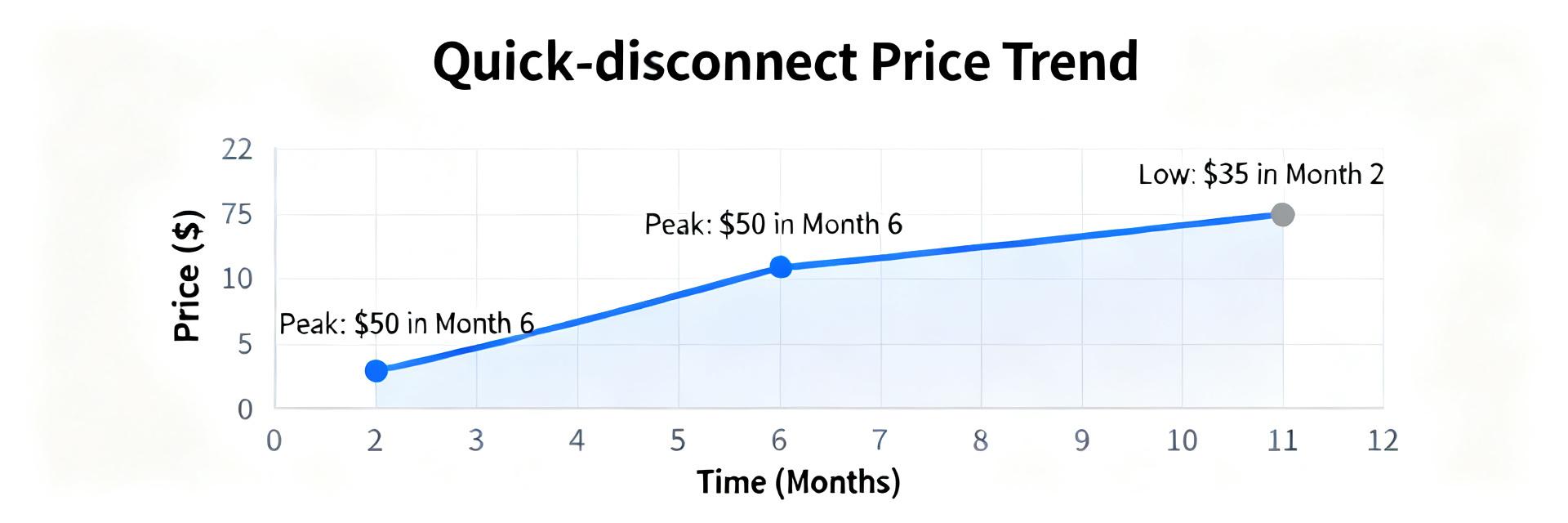
Point: current quoted price ranges show moderate dispersion driven by order size and lead time; short-term volatility is visible in smaller-lot quotes. Evidence: recent market quote snapshots place low–high ranges in the sample band with +/-10% intra-quarter swings tied to demand spikes and production lead-time shifts. Explanation: tracking unit quotes over 3, 6, and 12 months and normalizing for quantity gives a clearer signal of price trends versus one-off marketplace outliers.
Recent price range, volatility indicators & drivers
Point: primary drivers are raw-material input costs, capacity utilization at contract factories, and currency effects on imported components. Evidence: price volatility indicators include widening bid–ask ranges, multiple rapid supplier repricings, and growing freight surcharges. Explanation: buyers should track a simple rolling median price and a volatility band; when the quoted range widens beyond historical volatility, treat prices as signaling a tightening market.
Scenario-based forecast
Point: present three scenarios — base, constrained, and demand-pickup — with distinct price outcomes. Evidence: under a base case, prices remain within +/-5% over the next quarter; constrained supply can drive +10–25% within 1–3 months if lead times extend; a demand surge may create transient spikes followed by partial normalization. Explanation: label assumptions (factory uptime, freight stability) and attach confidence levels to each scenario when communicating to stakeholders.
Procurement Playbook: How Buyers Should Respond Right Now
Point: immediate sourcing tactics reduce exposure while controlling costs. Evidence: procurement teams that implement tiered POs and staggered replenishment see fewer schedule slips. Explanation: tactical moves include setting safety-stock targets based on weeks-of-cover, splitting orders across lanes, qualifying approved alternatives, and applying allocation clauses to POs to manage supplier prioritization.
Sourcing tactics and inventory rules
Point: checklist — safety-stock (4–8 weeks for critical lines), staggered POs, blanket orders with release schedules, and pre-approved alternates. Evidence: red flags to escalate: sudden single-source notices, cancelled ETAs, or rapid price jumps. Explanation: operationalize these rules in procurement SLAs and run weekly reconciliation of predicted vs. actual receipts to detect divergence early.
Contracting & negotiation levers
Point: negotiation levers include volume discounts, firm lead-time commitments, price-protection windows, and documented penalty or remedy clauses. Evidence: short price-protection windows of 30–90 days can limit exposure while leaving flexibility. Explanation: document agreed prices and delivery schedules in PO attachments and require supplier confirmation of release schedules for large replenishment orders.
Example Scenarios & Quick Case Walkthroughs
Point: real-world approaches differ by buyer scale and urgency. Evidence: two concise walkthroughs — small OEM urgent buy and high-volume integrator mitigation plan — illustrate trade-offs. Explanation: practical steps map to cost, lead-time, and risk appetite, informing whether to absorb expedited fees or to replan delivery milestones.
Small OEM: single-project urgency
Point: when a single-project needs parts within 2–3 weeks, prioritized spot buys or expedited shipments are typical. Evidence: immediate purchase increases unit cost by a premium (often 10–30%) versus standard lead times. Explanation: recommended sequence — confirm critical quantity, request firm ETA, accept expedited lane if project-penalty cost exceeds premium, and document acceptance to control scope creep.
High-volume integrator: risk mitigation plan
Point: for large recurring buys, focus on rolling forecasts, multi-sourcing, and safety stock math to smooth supply shocks. Evidence: modeling safety stock at 6 weeks for critical couplings and splitting supply across two factories reduces single-point allocation risk. Explanation: expect budget impact if prices move +10–25%; bake hedging into annual procurement plans and negotiate price ramps tied to forecast accuracy.
Conclusion / Summary
- Availability posture: mixed channel signals with lead times clustered in immediate, short, and extended buckets; monitor channel feeds daily to detect ETA shifts and allocation notices promptly.
- Price direction: short-term volatility is present; treat widening quote ranges and repeated repricings as early warning signs that price trends may head higher, requiring protective contracting.
- Immediate actions: set safety-stock thresholds, stage staggered POs, and negotiate short price-protection windows while qualifying approved alternate sources to reduce single-supplier exposure.
FAQ
Where to buy UQDLS-04HSH02-L000 quickly in the US?
For fastest delivery, prioritize authorized domestic stock and regional distributors with same-day pick-pack capacity; validate inventory feeds and confirm firm ETAs before payment. Expedited freight and local warehouses shorten transit but can carry a 10–30% premium depending on quantity and urgency.
What are typical UQDLS-04HSH02-L000 lead time US expectations?
Expect three buckets: immediate (1–3 days) for small orders if stock exists, short (1–4 weeks) for moderate replenishment, and extended (4+ weeks) for bulk or when allocations apply. Use rolling weeks-of-cover metrics to size safety stock and trigger escalation when projected coverage falls below the target.
How should procurement track UQDLS-04HSH02-L000 price trends?
Track median quotes and a volatility band weekly, normalize prices by order quantity, and log source and timestamp for each quote. When the rolling median moves beyond historical volatility thresholds, elevate review and consider protective contract clauses or strategic buys to lock pricing.
Are there standard cross-brand alternatives for UQDLS-04HSH02-L000?
Yes, compatible quick-disconnect solutions exist within standard ISO and proprietary server-rack cooling lines. Always cross-reference the exact flow rate, thread size, and O-ring material compatibility (such as EPDM for water-glycol mixtures) to prevent critical interface leaks before replacing.


