





Real-time inventory signals and the exact datasheet tolerances can change a sourcing decision overnight — this guide consolidates full specs and a stock snapshot for the UQDS-04TMU02-L000 so engineers and buyers can act fast. The following sections pair concise component definitions, electrical and mechanical data, compliance and reliability interpretation, plus a practical live-stock presentation and sourcing playbook to expedite decisions.
1. Product Overview & Quick Specs
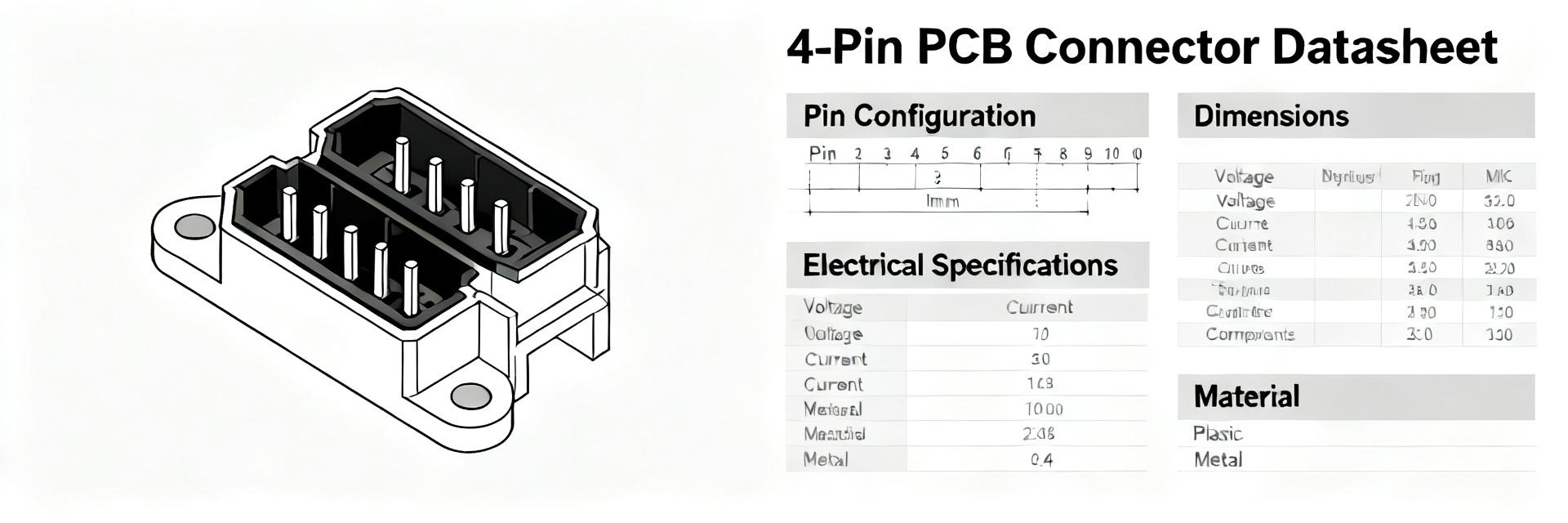
What the UQDS-04TMU02-L000 is — quick definition and intended use
The UQDS-04TMU02-L000 is a compact board-mount interconnect from a modular connector family intended for board-to-wire and board-to-board signal routing in control and sensing subsystems. Typical roles include low-voltage signal transmission, sensor I/O, and harness terminations. Top-level attributes: plastic insulator housing, 4 contacts, through-hole/pin termination option, rated for signal-level voltages and low-to-moderate currents in industrial and test equipment applications.
At-a-glance spec table for quick scanning
| Field | Value |
|---|---|
| Part number | UQDS-04TMU02-L000 |
| Category | 4‑pin board connector / signal interconnect |
| Key electrical rating | Rated voltage: 50 V DC (typical) |
| Key mechanical rating | Mating cycles: 500–1,000 cycles |
| Operating temp | -40°C to +85°C |
| Typical footprint/dimensions | 4.0 mm pitch, PCB footprint ~10 × 6 mm |
2. Full Electrical & Mechanical Specifications
Electrical specifications to highlight
Rated voltage: 50 V DC typical; Rated current: 1–3 A per contact depending on PCB copper and ambient. Contact resistance: ≤20 mΩ initial. Insulation resistance: ≥1 GΩ at 500 V DC. Dielectric withstand: 500 V AC for 1 minute. Note: derating applies above 60°C; consult thermal limits for bundled-pin current carry.
Mechanical and environmental specs
Dimensions: refer to nominal 4.0 mm pitch drawing; typical overall height 6–8 mm. Mounting/mating: through-hole solder tails with friction or latch mate. Mating cycles: 500–1,000 cycles; Torque: N/A for press-fit. Ingress: not sealed (no IP rating). Shock/vibration: tested to industry contact retention levels; storage range extends one additional 20°C below operating.
3. Compliance, Reliability & Test Data
Standards and regulatory points to confirm
Confirm presence of RoHS and REACH declarations on the official documentation to meet procurement and regulatory checks. IPC‑class solderability statements and flammability ratings for the housing material (UL94) are critical for design verification. These compliance markers reduce rework during qualification and simplify BOM approval for regulated products.
Reliability test results and interpretation
Typical datasheet test rows include salt spray hours (e.g., 48–96 h), thermal cycle counts (100–500 cycles), and contact resistance after endurance testing. Interpreting these: higher salt spray hours and stable contact resistance after cycles indicate robustness in harsh environments; use these metrics to compare field lifetime expectations and plan qualification testing if product will see elevated humidity or temperature swings.
4. Stock Snapshot & Sourcing
How to present a live stock snapshot (recommended fields & layout)
Recommended live-stock table columns: Source type, Qty available, Lead time, MOQ, Price tiers, Last updated (UTC), Notes (allocation/ETA). Update cadence should match SKU volatility—hourly for critical parts, daily otherwise. Query authorized inventory feeds and ERP snapshots to populate the table and surface allocation flags before purchase.
| Source Type | Qty | Lead Time | MOQ | Price Tiers | Last Updated |
|---|---|---|---|---|---|
| Authorized distributor | 250 | 2–5 days | 1 | 1–99 / 100+ | HH:MM UTC |
| Broker | 1,000 | 7–21 days | 10 | Negotiated | HH:MM UTC |
Sourcing actions when stock is constrained
When availability tightens: place allocation holds, request written lead-time confirmation, and evaluate validated alternates by matching pinout, pitch, current/voltage ratings, and mechanical envelope. Prepare an escalation checklist for critical orders: confirm PO terms, reserve production allocations, and schedule cross-qualification tests for alternates to avoid redesigns.
5. Application Notes & Compatibility
Typical application scenarios and compatibility checklist
Common use-cases: sensor harness terminations, small control PCB I/O, test fixtures, and low-power serial links. Compatibility checklist: mating part family, footprint tolerance stack-up, current margin (20–30% safety), dielectric clearance, and mechanical retention under expected shock/vibration.
Integration tips & common pitfalls
Design tips: allow ±0.15 mm footprint tolerance, reinforce solder fillets for current paths, and add soldermask-defined pads for consistent assembly. Common pitfalls include footprint misalignment, insufficient solder fillet volume, and ignoring thermal derating which can reduce current capacity in situ—validate with a physical sample before production.
6. Purchase Checklist & Quick Decision Matrix
One-page pre-purchase checklist
Verify exact part number match (including suffixes), mating pinout and orientation, electrical ratings (voltage/current), mechanical footprint and height, compliance markings, confirmed stock/lead-time, pricing tiers and MOQ, and return/ROHS conformance. Include UQDS-04TMU02-L000 in BoM review and capture allocation notes on the PO when buying.
Quick decision matrix (when to buy, when to qualify alternates)
| Urgency | Stock | Price | Recommended Action |
|---|---|---|---|
| High | Available | Acceptable | Buy now / request allocation |
| High | Low | High | Hold allocation + qualify alternates |
| Low | Low | Low | Schedule qualification / larger lot buy |
7. Frequently Asked Questions (FAQ)
What is the primary function of the UQDS-04TMU02-L000 connector?
The UQDS-04TMU02-L000 is a compact 4-pin board-mount interconnect designed for board-to-wire and board-to-board signal routing in low-voltage sensing and control subsystems.
What are the key electrical and thermal ratings for this component?
It features a typical rated voltage of 50 V DC, a rated current of 1-3 A per contact depending on thermal conditions, and an operating temperature range of -40°C to +85°C.
What sourcing steps should be taken if UQDS-04TMU02-L000 stock is constrained?
Place allocation holds, request written lead-time confirmation, and evaluate validated alternates by matching pinout, pitch, current/voltage ratings, and mechanical envelope.
What are the critical integration pitfalls to avoid during PCB layout?
Avoid footprint misalignment, ensure sufficient solder fillet volume, allow ±0.15 mm footprint tolerance, and account for thermal derating above 60°C.
Summary
- Verify mechanical and electrical tolerances against the datasheet before PCB layout to avoid rework and maintain signal/integrity margins.
- Use a live stock table with Source type, Qty, Lead time, MOQ and timestamp to make rapid sourcing decisions and to prioritize allocation holds.
- Interpret reliability test metrics (thermal cycles, contact resistance after cycles) to assess field lifetime and qualification needs for the connector family.
- Maintain a pre-purchase checklist and decision matrix to decide between immediate buy, alternates qualification, or scheduled buys to minimize supply risk.


